This is a copy of the Dec 17, 2025 Westword Arts & Culture Promotional Newsletter from which we are getting a wonderful response. The original had a black background ground and white text.
|

Dec 17
This is a copy of the Dec 17, 2025 Westword Arts & Culture Promotional Newsletter from which we are getting a wonderful response. The original had a black background ground and white text.
|
Dec 10

This past May, while watching the PBS Newshour, there was a segment about neuro arts. Journalist Jeffrey Brown visited the Johns Hopkins Medical School in Baltimore for PBS’s arts and culture series, CANVAS. One of the topics was the book, ‘Your Brain On Art: How The Arts Transform Us,’ shows both the growth and importance of the field that connects the arts and our health. Here is the link to the program.
https://www.pbs.org/newshour/show/how-a-blend-of-science-and-art-is-improving-neurological-health
I wrote a blog about it on www.lumonics.net.
Susan Magsamen is co-author with Ivy Ross, vice president for design at Google, of “Your Brain on Art: How the Arts Transform Us.” She gave Jeffrey Brown a day’s tour of ongoing examples at the Johns Hopkins University School of Medicine, where she directs the International Arts and Mind Lab.
I connected recently with Susan on LinkedIn and she appreciates what we are doing at Lumonics where the intention of the light sculpture installation, the field trips, guided tours, and immersive performances is to promote well-being and stimulate creativity. Dr. Jomar Suarez, a psychiatrist, has written about the therapeutic potential of Lumonics.
Lumonics is honored to be invited to the Neuroarts Resource Center. We look forward to connecting with other art projects, researchers, and educators.
“The field of neuroarts is the study of how the arts and aesthetic experiences measurably change the brain, body, and behavior – and how this knowledge is translated into specific practices that advance health and wellbeing. The goal of the NeuroArts Blueprint initiative is to ensure that the arts and the use of the arts – in all of its many forms – become part of mainstream medicine and public health.”
The NRC is a first-of-its-kind online asset designed to bring diverse fields, people, and organizations together across the globe, through an easy-to-access platform.
The NeuroArts Blueprint Iniatiative
Neuroarts is the place where a growing body of research-based knowledge about how the brain and body respond to the experience of art is stored. And it is the springboard for interventions and programs that translate that knowledge into practice in clinics, homes, workplaces, and communities, all in service to individual and collective well-being.
Across time, in moments of personal and planetary stress, in rural and urban settings around the globe, people have sought artistic outlets to prevent or treat illness, express joy, soothe fear, ease grief, and build community. The oldest archeological discoveries reveal the longstanding human pursuit of self-expression and the most recent pandemic reminds us again that people turn to art in times of need. Now, scientists and artists are coming together to build a field based on a growing understanding of how the arts in all of its many modalities can advance health and wellbeing.
The goal of the NeuroArts Blueprint initiative is to change that, and ultimately to embed the arts into the fabric of mainstream medicine, public health, and more.
The time is right to build the field of neuroarts—defined as the study of how aesthetic experiences and the arts measurably change the brain, body, and behavior and how this knowledge is translated into practices that advance health and wellbeing. Anchored in robust science, innovative arts practices, and cutting-edge technology, the work is advancing on multiple fronts, building capacity and generating broad professional and public enthusiasm for the field.
The endeavor is being led by the NeuroArts Blueprint initiative, a partnership between the Johns Hopkins International Arts + Mind Lab Center for Applied Neuroaesthetics and the Aspen Institute’s Health, Medicine & Society Program. Established in 2019, the initiative is co-chaired by Renée Fleming, renowned soprano and arts advisor to the Kennedy Center, and Eric Nestler, MD, PhD, neuroscientist and dean of Academic and Scientific Affairs at Mount Sinai Medical Center. Susan Magsamen, MAS, executive director of the International Arts + Mind Lab, and Ruth J. Katz, JD, MPH, executive director of the Health, Medicine & Society Program, serve as co-directors. A 25-member Advisory Board, representing a deep bench of leaders engaged in neuroarts-related activities, contribute essential experience, wisdom, and personal and professional networks to drive the field’s development and growth.
Since its launch, the NeuroArts Blueprint initiative has operated at many levels to weave together a community of diverse stakeholders, including researchers across scientific fields; artists and arts practitioners in all disciplines; clinicians, patient advocates, and community activists; public health and education professionals; leaders in business, technology, and entertainment; architects and planners, policy makers and many others.
The NeuroArts Blueprint initiative also has helped to generate and share evidence that music, dance, visual arts, virtual reality, and numerous other art modalities can reduce disease symptoms, improve physical and emotional health, influence brain development, and foster educational achievements associated with health and wellbeing over a lifetime.
– NeuroArts Blueprint: Advancing the Science of Arts, Health, and Wellbeing : Neuroarts Resource Center
Dec 10
After serving in combat in WW II, Mel Tanner enrolled at the Brooklyn Museum Art School under the new G.I. Bill. This photo was on the cover of the 1950-51 School Catalog. Max Beckmann (foreground), Mel Tanner (far right).
Mel was a student in Mr. Beckmann’s painting class. Max Beckmann died in 1950. Mel Tanner died in 1993. Dorothy was also a student at “The Brooklyn” where they met and married in 1951.
* photo courtesy of the Special Library Collections at The Brooklyn Museum ©1950

More Photos from that era on the Lumonics Photo Archives webpage.
Nov 15
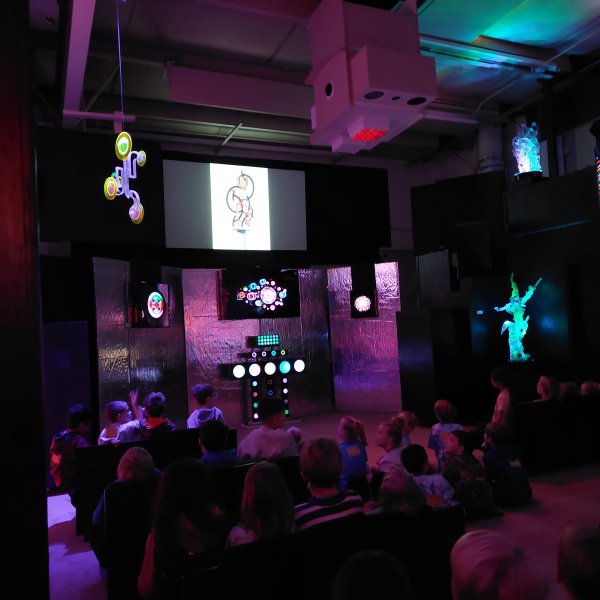
On November 14, 2025, we hosted first graders from Leawood Elementary school in Jefferson County, Colorado. In the above photo, students are watching the first segment of the field trip, “The Art of Seeing”, video of many Lumonics art works. The video is intended to train students’ eyes when they look at art. It has a meditative soundtrack to relax them.
The field trip also included a brief documentary, a light and sound immersion, a tour of the gallery and light art school, a brief session on how we present the immersion led by Marc Billard, and a question and answer session.
They were a wonderful group of students!